
10 Reasons Your Small Business Scaling Strategy Isn’t Working (And How to Fix It)
by Johnny Tellez | Jun 8, 2026

Most small business owners don’t struggle with scaling because they lack effort. They struggle because they are trying to grow a structure that hasn't been built to hold the weight.
I’ve spent over 20 years in the trenches of franchise systems and multi-unit operations. What I’ve seen time and again is that scaling isn't about working harder, it’s about creating a business that can run without your constant "heroics." Many founders find themselves in a cycle where growth actually feels like a punishment. The more customers they get, the more stressed they become, and the more the wheels start to wobble.
If you feel like your business has hit a ceiling, or if growth is creating more chaos than clarity, it’s usually because of one (or several) of these operational gaps.
Here are 10 reasons your scaling strategy might be stalling and how we can start to fix it.
1. The Founder Bottleneck
This is the most common roadblock I see. In the beginning, you had to be the one to do everything. You were the sales team, the customer service, and the operations manager. But as you scale, that same "do-it-all" mentality becomes a chokehold on the business.
If every decision, no matter how small, has to cross your desk, you are the bottleneck. Your team stops thinking for themselves and starts waiting for your "okay." To fix this, you have to move the business out of your head and into a system. You need to define clear decision rights: who can decide what, and at what level?

2. You’re Scaling a Leak
Scaling doesn't fix a broken business model; it just makes the cracks bigger. If your profit margins are thin or your customer retention is poor, adding more customers will only accelerate the problem.
Before you focus on "more," you have to focus on "better." At El Jefe Enterprises, we often talk about Clarity over Sales. You need to ensure your current operation is healthy and profitable before you try to replicate it.
3. Lack of Documented SOPs
If I walked into your business today and asked three different employees how to handle a specific task, would I get three different answers? If the answer is yes, you don't have a system; you have a collection of habits.
Standard Operating Procedures (SOPs) aren't just corporate busywork. They are the "instruction manual" for your business. Without them, you can’t train effectively, you can't inspect quality, and you certainly can’t scale. Start by documenting your top five most frequent processes. Keep it simple: Purpose, Owner, Steps, and what "Done" looks like.
4. Hiring for a Pulse, Not for Fit
When you're overwhelmed, it's easy to fall into the "I just need a body" trap. You hire the first person who seems capable of doing the task so you can get some relief.
But a bad hire is more expensive than no hire. Scaling requires people who can own their roles, not just follow instructions. You need a structured hiring process that looks for alignment with your values and the specific skills required for the system you’ve built.
5. Ignoring Accountability Rhythms
Consistency is the heartbeat of a successful business. Many founders avoid "meetings" because they’ve been in too many bad ones. But without a regular rhythm of accountability, your team loses focus.
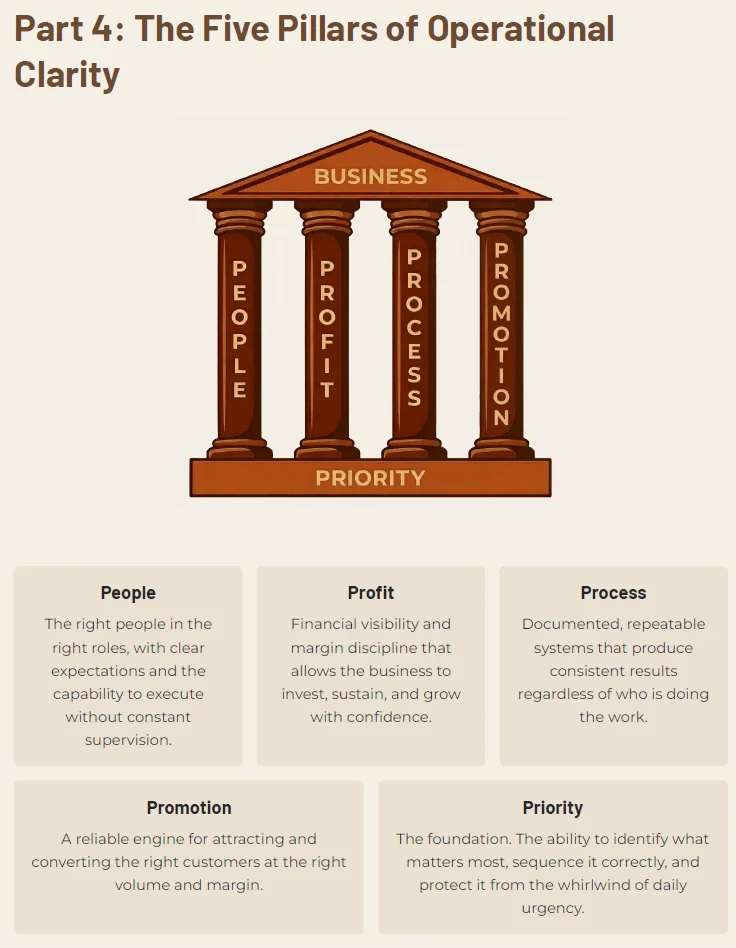
We believe in The Five Pillars of Operational Clarity: People, Profit, Process, and Promotion, all built on a foundation of Priority. You need a weekly rhythm: a scorecard of 5-10 key numbers and a quick meeting to review priorities and unblock obstacles.
6. Complexity Over Simplicity
Growth often brings complexity, but complexity is the enemy of execution. I see many owners adding more software, more layers of management, and more "innovative" strategies before they’ve mastered the basics.
The goal is not more complexity; the goal is better rhythm. If a process is too hard to teach, it’s too hard to scale. Strip away the fluff and focus on the core actions that drive your business forward.
7. Inconsistent Training
Training is not a one-time event that happens during onboarding; it is a continuous process. If you find yourself constantly "fixing" the same mistakes, it’s a training problem, not a people problem.
Training should create confidence, not just compliance. When you have documented SOPs, training becomes much easier. You’re not teaching people "your way" of doing things; you’re teaching them the "business way."

8. Financial Blind Spots
Scaling requires capital and a deep understanding of your unit economics. If you don't know your customer acquisition cost (CAC), your lifetime value (LTV), or your true labor costs, you are flying blind.
Intuition is great for starting a business, but data is required to scale one. You need a clear view of your numbers every single week to make informed, confident decisions.
9. A Culture of "Heroics"
In many small businesses, the "star employees" are the ones who stay late and "save the day" when things go wrong. While that effort is appreciated, a culture that requires heroics to function is a culture that is failing.
You want a culture of standards. A successful business is one where the day-to-day work is predictable and repeatable. If you constantly need someone to "save the day," your systems are broken. Focus on building a culture where following the process is the win.
10. Weak Feedback Loops
As you move away from the front lines of the business, you lose the "feel" for what’s happening on the ground. If you don't have a formal way to get feedback from your team and your customers, you’ll start making decisions based on outdated information.
Create simple loops: a monthly team survey, a "what’s frustrating you" box, or regular customer check-ins. This keeps you grounded in reality while you focus on the vision.
Moving Toward Clarity
Scaling isn't an overnight transformation; it’s a series of intentional shifts. It’s moving from "I do it" to "we do it" to "the system does it."
If you feel like too much of the business still lives in your head, the first step is to slow down just enough to get those ideas on paper. You don't need a 200-page manual; you need a few clear tracks for your team to run on.
If your business is growing but the work still feels chaotic, it may be time to stop working in the business and start building the structure that will allow it to scale without you. The right next step is usually not more complexity: it is clearer structure.
If you’re ready to move from chaos to clarity, let's look at the process behind the problem together.
Let’s talk about your next move
No pressure and no obligation. The goal of the first conversation is simple: clarity.
Book a callRelated reading
Is a Franchise Consultant Really Free? How It Works in Atlanta
by Johnny Tellez | Oct 26, 2026
Short answer: yes. A good franchise consultant costs you nothing. That's usually the moment people get suspicious. Fair enough. If you're thinking about buying a franchise in Atlanta, you should know exactly who's paying, why, and what that means for the advice you get…
Read more
Business Coaching in Atlanta: 7 Signs Your Small Business Is Ready for a Coach
by Johnny Tellez | Oct 26, 2026
Atlanta is one of the best places in the country to own a small business. From Buckhead to Decatur, from Marietta to the Westside, owners are opening shops, service companies and franchises every week. But building something and running it well are two different jobs. A lot of good owners hit a point where hard work alone stops…
Read more
Is Your Business Stuck? Here’s How the Five Pillars of Operational Clarity Diagnose the Real Problem
by Johnny Tellez | Oct 1, 2026
Most business owners don’t realize they are stuck until they are exhausted. You started with a vision. You had the energy. But somewhere between opening the doors and reaching your first major milestone, the "grind" became the "norm." You find yourself putting out the same fires every Tuesday, answering the same questions from your team…
Read more