5 Steps to Move from Founder-Led to System-Led (Practical Guide for Scaling a Small Business)
by Johnny Tellez | Jul 4, 2026

In the early days of building a business, your personal energy is the fuel. You are the chief salesperson, the lead technician, the customer service department, and the person who knows exactly where the spare keys are hidden. This "founder-led" stage is necessary to get off the ground. It’s gritty, it’s exciting, and it’s how you prove your concept.
But eventually, that same energy becomes the ceiling.
If every decision has to cross your desk, you aren't a CEO; you’re a bottleneck. If the business stops moving the moment you take a weekend off, you don’t own a business: you own a high-pressure job.
Moving from founder-led to system-led is the most difficult transition an entrepreneur will ever make. It requires shifting from "heroics" to "rhythm." Based on my 20+ years in senior operations and franchise systems with brands like Blaze Pizza and Focus Brands, I’ve seen that the most successful scaling a small business strategy isn't about working harder; it’s about building a machine that works without you.
Here is a practical, 5-step roadmap to get the business out of your head and into a system that can scale.
1. Admit You Are the Current Bottleneck
Most operational problems don't start as major failures. They start as small gaps in clarity that the founder fills with their own effort. When a team member doesn't know how to handle a customer complaint, they ask you. When a vendor is late, you fix it.
The first step is a "Business Audit" of your own time. For one week, track every time a team member comes to you with a question or a problem. Ask yourself: Did they ask me because they aren't capable, or because the answer only lives in my head?
Most of the time, it’s the latter. Scaling a small business requires you to stop being the "Chief Problem Solver" and start being the "Chief Systems Designer." You have to decide that your role is no longer to do the work, but to ensure the system does the work to your standards.
2. Extract the "Mental Manual"

You have a "mental manual" of how your business should run. You know exactly what a "good" customer interaction looks like. You know how the floors should be swept and how the marketing emails should sound. The problem is, your team can’t read your mind.
To move to a system-led model, you must codify these expectations. Don’t start with a 200-page manual; no one will read it. Start with the "Must-Not-Fail" steps.
- Document the Lead-to-Customer journey: How do people find you, and exactly what happens next?
- Create Checklists, not just SOPs: A checklist is a tool for execution; an SOP is a tool for training. Both are needed, but the checklist is what ensures consistency on a Tuesday morning at 8:00 AM.
- Use Video: Sometimes a 2-minute Loom video of you performing a task is more effective than five pages of text.
The goal is operational clarity. When the process is documented, you stop managing people and start managing the process. If a mistake happens, you don't ask "Who messed up?" You ask "Where did the process fail?"
3. Implement the Five Pillars of Operational Clarity
At El Jefe Enterprises, we guide our clients through a framework we call the Five Pillars of Operational Clarity. This is the structural architecture of a system-led business. If you want to scale, every one of these pillars must be documented and owned.
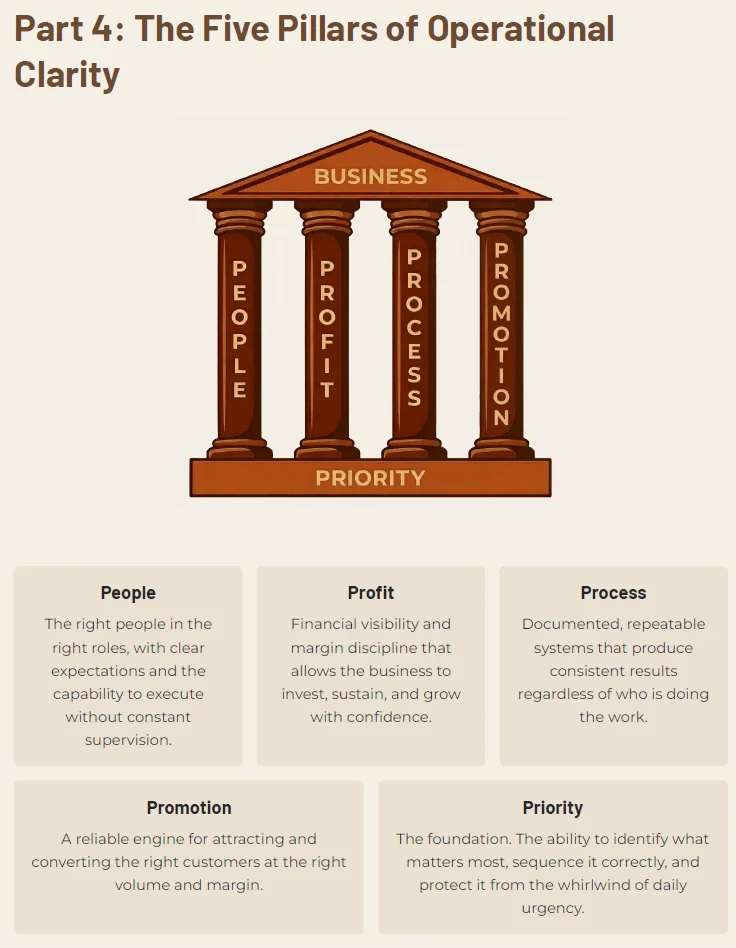
- People: Who owns what? Clarify roles and expectations so there is no "I thought you were doing that" in your organization.
- Profit: How do we make, keep, and measure money? You need a simple scorecard that reflects the financial health of the business without you having to dig through bank statements.
- Process: How does the work get done? These are your repeatable workflows and quality controls.
- Promotion: How do we attract demand? A system-led business has a repeatable way to generate leads that doesn't rely on the founder’s personal network alone.
- Priority: What matters right now? This is the "rhythm" of the business: the 1-3 big goals for the quarter that everyone is aligned on.
If you feel stuck, our Strategic Deep Dive is designed to help you map these pillars specifically to your business model.
4. Install a "Management by Metrics" Rhythm
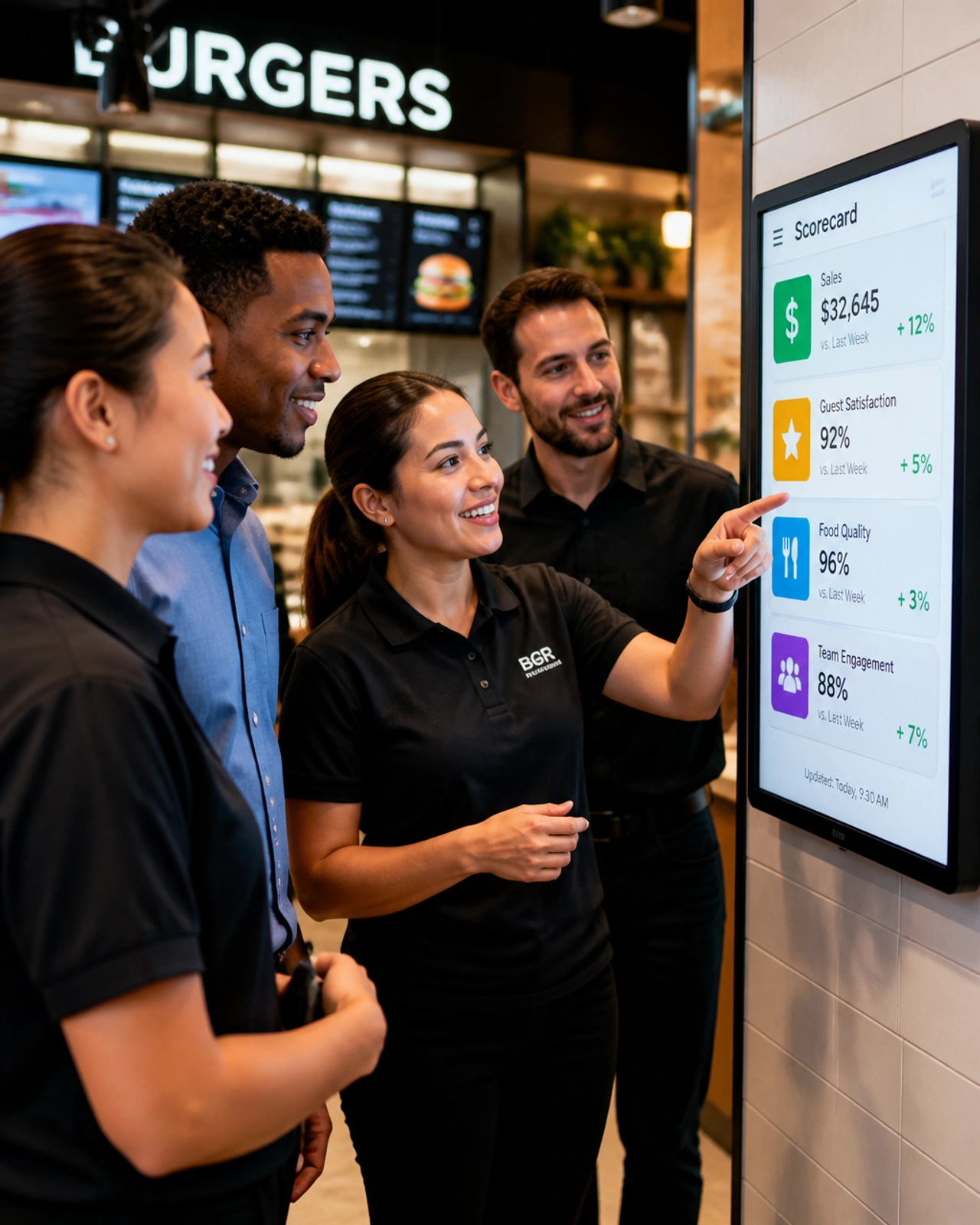
Founders often lead by "gut feel." They can sense when sales are down or when the team is stressed. But gut feel doesn't scale. You can't be in three locations at once sensing the "vibe."
A system-led business runs on an operating rhythm. This means:
- Weekly Leadership Meetings: A 60-minute, structured meeting to review the scorecard, track priorities, and solve "rocks" (bottlenecks).
- Simple Dashboards: Every department should have 3–5 key metrics (KPIs) they are responsible for. If you’re a business coach or consultant, you know that what gets measured gets managed.
- Inspecting what you Expect: You don't need to do the work, but you must have a system to inspect it. This could be a weekly walkthrough, a mystery shop, or a data review.
This rhythm creates accountability. When the team knows the numbers are being watched, and they have the tools to influence those numbers, they take ownership.
5. Build the Leadership Feedback Loop
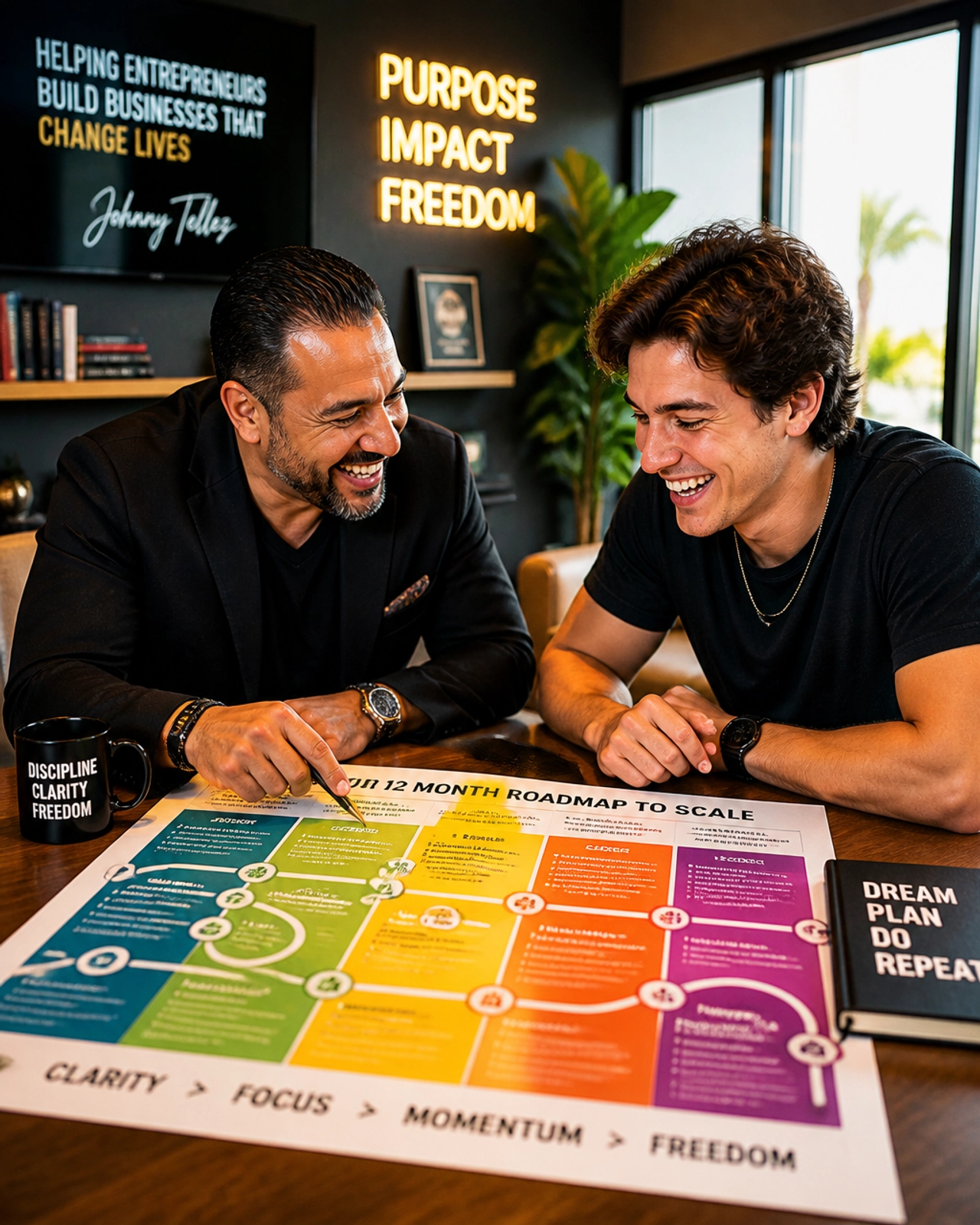
The final step in moving away from a founder-led model is developing your people. You are no longer the "Star Player"; you are the "Head Coach."
Strategic delegation is not "abdication." You don't just throw a task at someone and hope for the best. You give them:
- The Goal: What does success look like?
- The Process: Here is the documented way we do this.
- The Authority: You have the power to make these specific decisions.
- The Accountability: We will review the results every Tuesday.
As a franchise consultant and advisor, I often tell people looking at the best franchises to own that the value of a franchise isn't the brand name: it's the system. The most successful small business growth strategy is to treat your independent business as if it were a franchise. Build the playbooks, train the leaders, and create the consistency that allows the brand to live beyond your physical presence.
Moving Forward with Confidence
Transitioning from founder-led to system-led is rarely a straight line. It’s a series of small shifts that eventually lead to a massive breakthrough in freedom and scalability. It requires due diligence not just in your market, but in your internal operations.
If your business has outgrown the "mental manual" in your head, it’s time to start building the structure that supports your next level of growth. Whether you are looking to franchise your current brand or simply want to reclaim your time, the answer is always operational clarity.
The goal is not more complexity. The goal is better rhythm, clearer structure, and stronger execution.
Are you ready to see where your business stands? Take our Operational Readiness Assessment to identify the gaps in your current systems and start your journey toward a system-led future.
Let’s talk about your next move
No pressure and no obligation. The goal of the first conversation is simple: clarity.
Book a callRelated reading

Is a Franchise Consultant Really Free? How It Works in Atlanta
by Johnny Tellez | Oct 26, 2026
Short answer: yes. A good franchise consultant costs you nothing. That's usually the moment people get suspicious. Fair enough. If you're thinking about buying a franchise in Atlanta, you should know exactly who's paying, why, and what that means for the advice you get…
Read more
Business Coaching in Atlanta: 7 Signs Your Small Business Is Ready for a Coach
by Johnny Tellez | Oct 26, 2026
Atlanta is one of the best places in the country to own a small business. From Buckhead to Decatur, from Marietta to the Westside, owners are opening shops, service companies and franchises every week. But building something and running it well are two different jobs. A lot of good owners hit a point where hard work alone stops…
Read more
Is Your Business Stuck? Here’s How the Five Pillars of Operational Clarity Diagnose the Real Problem
by Johnny Tellez | Oct 1, 2026
Most business owners don’t realize they are stuck until they are exhausted. You started with a vision. You had the energy. But somewhere between opening the doors and reaching your first major milestone, the "grind" became the "norm." You find yourself putting out the same fires every Tuesday, answering the same questions from your team…
Read more