
Franchise Consulting in Atlanta: What a Week of Franchisor Calls Teaches About Fit
by Johnny Tellez | Nov 9, 2026

Early this month we spent two straight days on calls with franchise development leaders. Restoration, plumbing, dryer vent and duct cleaning, payroll services and digital marketing consulting, one after another. Different industries, different price points, different cultures. But by the end of the second day the same handful of lessons kept coming up, and almost none of them were about the brand name.
If you're thinking about buying a franchise in Atlanta, here's what those conversations teach about fit, and the questions worth asking before you sign anything. This is the heart of how we approach franchise consulting: the right franchise is the one that fits the owner you are and the life you want, not the one with the loudest pitch.
1. Every brand has an owner it was built for
Every franchisor we spoke with could describe their best owner in a sentence or two. One wanted former corporate leaders from business development, marketing or finance who are comfortable advising other businesses and have no interest in running a storefront. Another said its strongest owners have a business development mindset rather than an accounting background, and that couples and partner teams tend to do especially well. A home services brand said its best operators often come from multi-unit operations backgrounds, because they already understand how to run a business at scale.
That's useful information for you as a buyer. Ask every franchisor, plainly, who their most successful owners are and what those people did before. If the answer sounds nothing like you, take that seriously. You're not just buying a business model. You're buying the daily job that comes with it.
2. Know the daily rhythm before you fall for the model
Two businesses can look similar on paper and feel completely different on a Tuesday night. A restoration brand was clear that its business runs 24 hours a day, 365 days a year, and isn't built for absentee owners. A dryer vent and duct brand described a calmer day, with no special licensing required and most of the work coming from steady relationships with property managers. A payroll brand runs fully remote with no office at all, and its owners spend their days building relationships with accountants, attorneys, bankers and insurance agents.
None of those is better than the others. They're different lives. Before you compare investment ranges, picture the day: who calls you, when, and what you'll be doing at 7 AM and 7 PM. This is the Priority pillar in action. Your business should serve the life you want, not quietly replace it.
3. "Semi-absentee" usually means "not at first"
Several brands said the same thing in different words: the early stage is full-time. One called it the opposite of a nights-and-weekends side hustle. Another described a growth path that starts as owner-operator, moves to managing a manager, and only later becomes running several territories as the CEO. Even the brands with lighter models expect you to be out networking, knocking on doors and building your first accounts yourself.
If your plan depends on keeping your current job for the first year, say so on the very first call and listen closely to the answer. A good franchisor will tell you the truth. A great one will tell you if it isn't a fit.
4. Ask how fast they grew, and whether they ever slowed down
Some of the most reassuring things we heard were about restraint. One brand admitted it had grown too fast early on, paused selling new territories and right-sized its system before growing again. Another said it had removed underperformers and bad actors and spent the year focused on quality before scaling. A third deliberately limits how many new owners it takes on to what its support team can actually handle.
That kind of honesty is a green light, not a red flag. Ask every franchisor how many new owners they brought on last year, how big their support team is, and whether they've ever slowed growth on purpose. A brand that protects its existing owners is more likely to protect you.
5. Look for concentration risk
One restoration leader shared a rule we loved: never let national insurance programs become more than a small share of your revenue. He'd watched owners in another system lean almost entirely on a single insurance partner, then struggle badly when that partner changed its program overnight. The same principle applies everywhere. If most of your revenue depends on one referral source, one platform or one big customer, you don't fully control your business.
Ask where a typical owner's customers actually come from: relationships, digital ads, national accounts, referrals. A healthy mix usually means a sturdier business. This is the Promotion pillar, and it matters as much in a franchise as in a business you build from scratch.
6. Understand the ramp and the cash timing
Every model has a ramp. One brand gets owners open within about a month, with corporate building their map listings, local web pages and phone setup while the owner goes out and networks. Another gives new owners a 90-day launch plan with a target list of commercial accounts and weekly check-ins, and expects owners to follow it. Others add trucks or team members on a planned schedule through the first year.
Just as important is when the money arrives. In businesses that bill insurance companies, payment can lag by months, which is exactly why one leader advised against taking on too many territories too quickly. Ask how long it typically takes owners to break even, what the first year's hiring plan looks like, and how long you'll wait to get paid on a typical job. That's the Profit pillar: not just what the business can earn, but when.
7. Support should be specific, not a slogan
"Great support" means nothing until you know what it includes. The brands that stood out could name it: free industry certification and ongoing training seats for staff, a shared system that benchmarks every owner's numbers and has coaches step in when a metric turns red, a corporate team that handles back-office work for your first clients, or automatic reminders that bring past customers back. That's the Process pillar, and it's what you're really paying for when you buy a franchise.
Ask exactly what support looks like in month one, month six and year three, and then confirm it with current owners during validation. What owners tell you matters more than what the brochure says.
The question underneath all the others
By the end of those calls, the pattern was clear. Every franchisor was trying to answer one question about each candidate: will this person thrive running this specific business? Your job as a buyer is to ask the same question back. Who succeeds here, what does the day look like, how fast can it grow, where does the revenue come from, and what happens when something goes wrong?
That's what good Atlanta franchise consulting is for. We help Atlanta buyers get clear on their own goals first, using the Five P's of People, Profit, Process, Promotion and Priority, and then compare brands against that picture instead of against each other's marketing. When the fit is right, the decision gets a lot easier.
We Build Bosses. Let's Make You The Boss.
Exploring franchise ownership in Atlanta? Request more info and we'll help you figure out which kind of business actually fits you, or head back to the El Jefe Enterprises home page to learn more about how we work.
Let’s talk about your next move
No pressure and no obligation. The goal of the first conversation is simple: clarity.
Book a callRelated reading
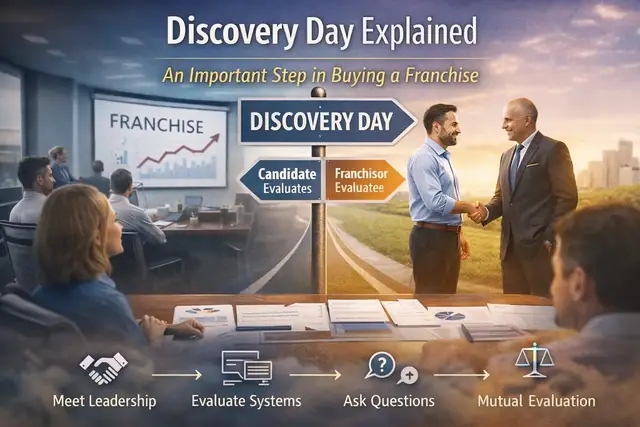
Discovery Day Explained: One of the Most Important Steps in Buying a Franchise
by Johnny Tellez | Mar 13, 2026
A practical guide to Discovery Day, why it matters in the franchise buying process, and how to prepare for it the right way.
Read more about Discovery Day Explained: One of the Most Important Steps in Buying a Franchise