How to Integrate AI With Your Business Training Systems (Without Losing Your Culture)
by Johnny Tellez | Jun 9, 2026

If you’ve spent five minutes on LinkedIn lately, you’ve probably seen a hundred posts about how AI is going to "disrupt" everything you know about business. It’s usually wrapped in a lot of hype about "10x growth" and "game-changing automation."
But in the real world: the world where you have actual employees, real customers, and a brand culture to protect: AI isn’t a magic wand. It’s a tool. And like any tool, if you pick it up without a plan, you’re more likely to break something than build something.
When it comes to training your team, the biggest fear I hear from business owners is that bringing in more technology will strip away the "human" part of their business. They worry that their culture will get swallowed by algorithms and that their employees will feel like they’re being watched by a robot rather than coached by a leader.
The truth is, you can integrate AI into your training systems without losing your soul. In fact, if you do it right, AI can actually strengthen your culture by removing the friction that usually kills momentum.
Here is how we look at AI-driven training at El Jefe Enterprises: not as a replacement for leadership, but as a way to turn your expectations into habits.
1. Training as a Cultural Signal
Every way you deliver information to your team sends a message. If your training is a dusty binder in the back office that nobody touches, the message is: "Our standards are a suggestion." If your training is a four-hour "event" that happens once a year, the message is: "We value compliance over competence."
When you introduce AI into your training stack, you are sending a new signal.
AI-driven platforms can personalize learning paths for every individual. Instead of making your veteran manager sit through the same "Intro to Safety" video as the new hire, the system recognizes their skill level and gives them what they actually need.
The cultural message here is powerful: "We value your time, we recognize your expertise, and we are invested in your specific growth."
At El Jefe Enterprises, we believe that operational excellence starts with clarity. By using AI to tailor the training experience, you provide that clarity without the "one-size-fits-none" approach that usually leads to disengagement.
2. Support, Not Surveillance
One of the biggest hurdles to AI integration is the "Big Brother" factor. If employees think you’re using AI to "watch" them or find reasons to write them up, they will resist it.
The shift you have to make: and communicate: is moving from surveillance to support.
Think of AI as a digital coach or a "nudge." Instead of a manager having to remember to remind a team member about a specific closing procedure, the system can send a quick, helpful nudge at exactly the right time.
For example, if the data shows a certain station is running behind, the AI doesn't just flag it to the boss; it offers the employee a 30-second tip on how to optimize their workflow.
When you position AI as a tool for excellence and support, it stops being scary. It becomes the thing that helps your team win the day. As we discuss in our Raising the Floor guide, what gets tolerated becomes the standard. AI helps you stop "tolerating" small gaps by providing the support needed to close them before they become big problems.
3. Fighting the "Forgetting Curve" with Just-in-Time Learning
We’ve all been there: You spend all day training a new hire, they seem to get it, and three days later they’re doing it the old way again.
This isn't usually a lack of "will": it's the Forgetting Curve. Human beings forget about 70% of what they learn within 24 hours if it isn't reinforced.

This is where AI shines. It enables "Just-in-Time" learning.
Instead of overwhelming someone with a firehose of information during onboarding, you can use AI to deliver micro-learning: bite-sized, 60-second reinforcements: at the moment of need.
- Need to troubleshoot the espresso machine? Scan a QR code, and an AI-driven video walks you through the fix.
- Forget the specific policy for a refund? A quick voice query to the system gives you the answer instantly.
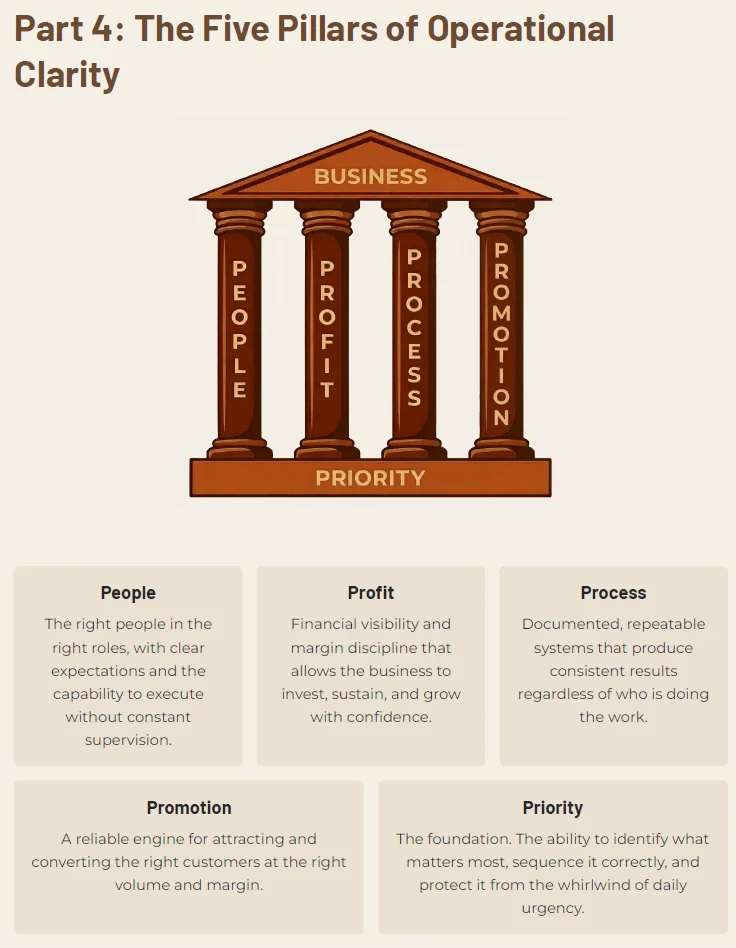
This reinforcement turns training from an "event" into a "rhythm." It stops the "whirlwind" of daily chaos from pulling your team back into bad habits.
4. The Blended Learning Model: AI + Mentorship
Let’s be clear: AI should complement, not replace, mentorship.
Hands-on training (OJT) is where the soul of your business lives. It’s where your culture is caught, not just taught. You cannot replace the value of a seasoned leader showing a new team member the "why" behind the "how."
However, AI can handle the "how" so that your leaders can focus on the "why."
We call this Blended Learning. Use AI to ensure consistency in the basics: technical skills, safety protocols, and standard operating procedures (SOPs). This ensures that every single person, regardless of location or shift, is getting the same foundation.
Once that foundation is set by the system, your managers can step in to provide the high-touch mentorship that builds trust and loyalty. AI ensures the "floor" is high, while your leadership raises the "ceiling."
5. Complexity is the Killer
After 20+ years in operations, if there is one thing I’ve learned, it’s that complexity is the killer of momentum.
When people look at AI, they often try to make it too complicated. They want the most advanced, expensive system with all the bells and whistles. But if a system is hard to use, your team won't use it.
My advice? Start simple.
AI should make the job easier, not add "weight" to the workday. If your AI integration requires a 50-page manual to understand, you’ve already lost.
The goal isn't to be a "tech-forward" company. The goal is to be an execution-forward company. Use technology to simplify the complex, clarify the confusing, and give your people the confidence they need to deliver on your brand promise every single shift.
Moving Forward With Confidence
Integrating AI doesn't mean you’re turning your business into a cold, clinical machine. It means you are giving your humans better tools to be successful.
When you use AI to support your team, fight the forgetting curve, and create consistency, you aren't losing your culture: you’re protecting it. You’re ensuring that the standards you worked so hard to build are actually happening when you aren't in the room.
If your business is growing but your training systems still live in your head (or in a binder from 2015), it’s time to rethink your approach.
The right next step isn't more complexity. It’s a clearer structure.
Ready to get your operations out of the "whirlwind" and into a rhythm that scales? Let’s talk about how to build systems that work for your people, not against them. At El Jefe Enterprises, we help you find the clarity you need to move forward with confidence.
Let’s talk about your next move
No pressure and no obligation. The goal of the first conversation is simple: clarity.
Book a callRelated reading

Is a Franchise Consultant Really Free? How It Works in Atlanta
by Johnny Tellez | Oct 26, 2026
Short answer: yes. A good franchise consultant costs you nothing. That's usually the moment people get suspicious. Fair enough. If you're thinking about buying a franchise in Atlanta, you should know exactly who's paying, why, and what that means for the advice you get…
Read more
Business Coaching in Atlanta: 7 Signs Your Small Business Is Ready for a Coach
by Johnny Tellez | Oct 26, 2026
Atlanta is one of the best places in the country to own a small business. From Buckhead to Decatur, from Marietta to the Westside, owners are opening shops, service companies and franchises every week. But building something and running it well are two different jobs. A lot of good owners hit a point where hard work alone stops…
Read more
Is Your Business Stuck? Here’s How the Five Pillars of Operational Clarity Diagnose the Real Problem
by Johnny Tellez | Oct 1, 2026
Most business owners don’t realize they are stuck until they are exhausted. You started with a vision. You had the energy. But somewhere between opening the doors and reaching your first major milestone, the "grind" became the "norm." You find yourself putting out the same fires every Tuesday, answering the same questions from your team…
Read more