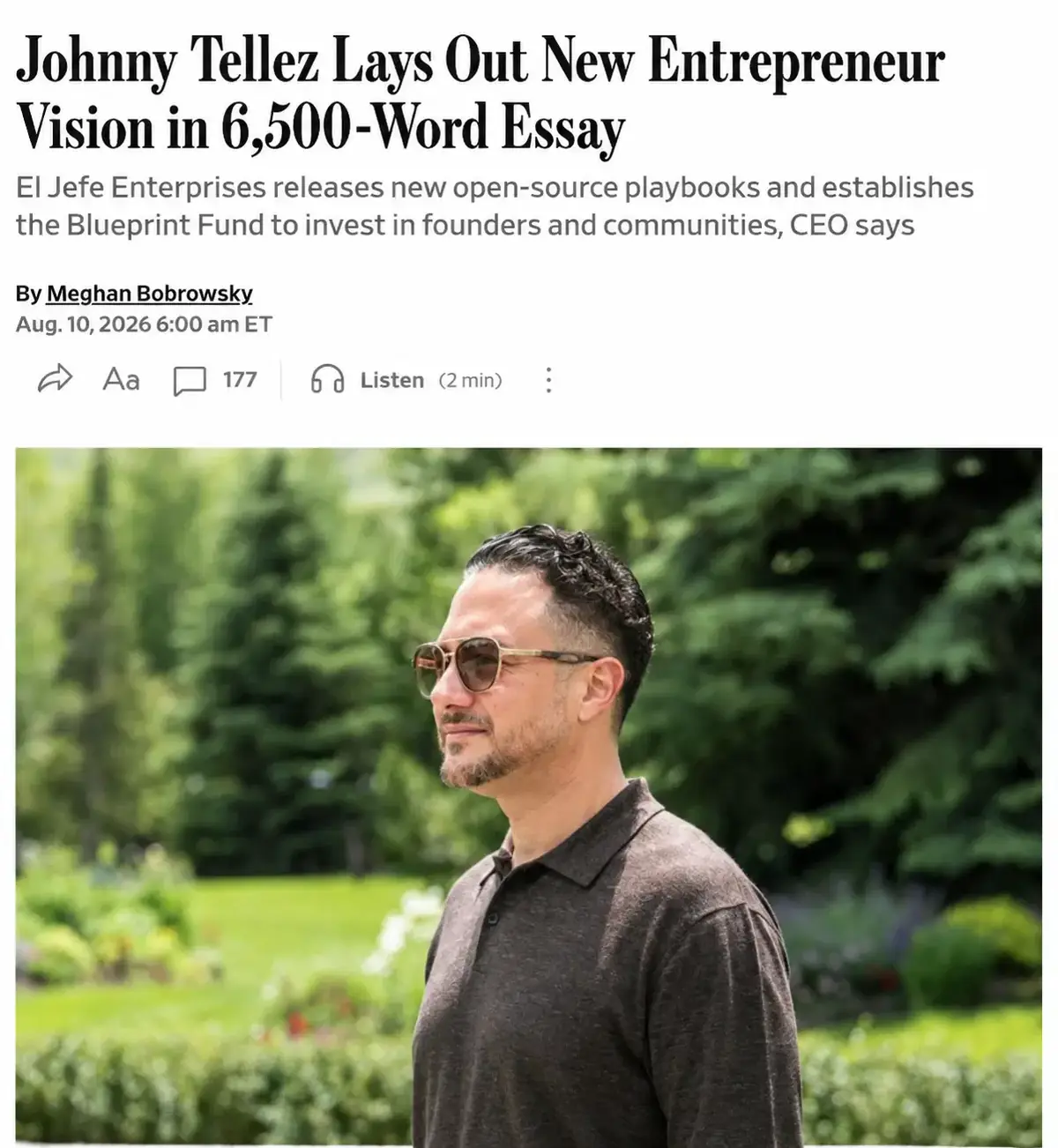
Johnny Tellez Lays Out New Entrepreneur Vision in 6,500-Word Essay
by Johnny Tellez | Aug 10, 2026
Building an Entrepreneurial Future That Gives More People the Ability to Find Their Path, Simplify the Complex, and Build Something That Lasts
I believe we are entering one of the most interesting periods for entrepreneurship that we have seen in generations. The barriers between having an idea and being able to do something meaningful with it are changing rapidly. Technology is giving individuals access to capabilities that once belonged almost exclusively to large organizations, new models of ownership are creating more ways for people to participate in business, and artificial intelligence is reducing the amount of time and specialized expertise required to move from thought to action. At the same time, I am not convinced that entrepreneurship itself is becoming simpler. If anything, the number of choices available to people has created a new kind of complexity, where the challenge is no longer finding information but deciding what information matters, what opportunity actually fits, and what deserves your attention next.
That distinction has become increasingly important to me as I have built El Jefe Enterprises. For more than twenty years, I worked inside restaurant, franchise, training, and operating systems at significant scale, eventually serving as Chief Operating Officer of Blaze Pizza and supporting organizations that reached thousands of operators across large multi-unit systems. My professional work has included roughly 2,000 units and learning environments supporting more than 60 languages. When you spend enough time around organizations of that size, you learn that growth is almost never the result of one extraordinary idea. Sustainable growth comes from the ability to connect a large number of relatively ordinary things—people, expectations, training, financial discipline, customer experience, leadership, systems, communication, and accountability—well enough that the organization can consistently deliver what it promises.
Moving from large corporate systems into entrepreneurship gave me the opportunity to see that same equation from the opposite direction. Large companies often struggle because they have accumulated too much infrastructure, too many processes, too many layers, and too many competing priorities. Small businesses frequently struggle because they have almost none of those things. The owner is the strategist, sales department, operations leader, recruiter, problem solver, financial reviewer, customer-service escalation point, and, on certain memorable afternoons, the person trying to figure out why the printer is no longer speaking to the Wi-Fi. Somewhere between corporate bureaucracy and entrepreneurial improvisation is a much better model, and that middle ground has become where I want to spend the next chapter of my career.
My vision for entrepreneurship is therefore not built around making every small business operate like a giant corporation. That would defeat much of what makes entrepreneurship valuable in the first place. Small businesses are often faster precisely because they are closer to the customer, closer to the problem, and closer to the people doing the work. They can make decisions without convening a committee to determine whether another committee should study the decision. What I believe we can do, however, is make some of the capabilities that have historically belonged to sophisticated organizations accessible to entrepreneurs without importing all of the complexity that came with them.
That means helping owners understand their economics without expecting them to become accountants. It means giving them practical strategic-planning tools without asking them to produce a hundred-page planning document. It means helping them develop managers without requiring a corporate leadership academy, document critical processes without building an encyclopedia, and use technology without creating another full-time job managing the technology that was supposedly going to save them time. Most of all, it means helping entrepreneurs developing enough understanding of their own businesses that they can make better decisions themselves rather than permanently depending upon somebody else to tell them what to do.
That idea—building capability rather than dependency—sits at the center of how I increasingly think about El Jefe Enterprises. The purpose of coaching and advisory work should not simply be to give someone answers. Answers are becoming cheaper every day. Artificial intelligence alone can produce more recommendations, strategies, outlines, plans, ideas, and frameworks in an afternoon than most entrepreneurs could reasonably implement in a decade. What remains scarce is judgment: understanding which answer fits this business, this owner, this market, this moment, and this set of resources.
That is why I believe the entrepreneurial advantage of the next decade will not belong simply to the people who have access to the most information. Almost everyone is going to have access to extraordinary amounts of information. The advantage will belong to people who can translate information into decisions, decisions into priorities, priorities into consistent behaviors, and consistent behaviors into results. In other words, the advantage will belong to better operators.
A New Era of Personal Enterprise
For much of modern economic history, the pathways available to individuals were relatively predictable. Most people worked for an organization, developed a profession or trade, joined a family enterprise, or took the substantial risk of starting something themselves. Those choices still exist, but they are now surrounded by a much broader spectrum of possibilities. Someone can buy a franchise, acquire an existing company, build an independent business, operate a professional practice, create intellectual property, develop a digital product, buy real estate, build a portfolio of businesses, or combine several of those paths across the course of a career.
I think this expansion of possibility matters because ownership can be one of the most powerful forms of personal agency available to people. Ownership allows someone to participate differently in the economy, but it also creates the ability to shape their work, influence their schedule, build an asset, create jobs, develop other people, and potentially build something that extends beyond their own career. None of that guarantees an easier life. Anyone suggesting that entrepreneurship is the easy path has either never owned a business or is preparing to sell you a course. Ownership creates different challenges, but for the right person, those challenges can be worth taking on.
The mistake we make is assuming that because entrepreneurship creates opportunity, everyone should pursue it in the same way. I do not believe there is one correct version of entrepreneurial success. One person may want to create a national franchise system with hundreds of locations, while another may want one excellent local business that generates a healthy income and allows them to be present with their family. One entrepreneur may want employees and infrastructure, while another may deliberately build a small advisory practice around their personal expertise. One person may want to build an asset to sell, while another wants to create something they can pass to their children.
Those outcomes are not arranged on a ladder where one is inherently more impressive than another. They represent different definitions of success, and one of the responsibilities we have when helping people explore entrepreneurship is to understand the definition before recommending the path. My work in franchise navigation has reinforced this repeatedly. The right question is rarely, “What franchise should you buy?” The better starting point is, “What are you actually trying to build, and what do you want ownership to make possible?”
That requires understanding far more than somebody’s preferred industry. Their financial capacity matters, but so does their tolerance for risk. Their professional experience matters, but so do the activities that naturally energize them. Their desired income matters, but so does the amount of time they want the business to require. Family considerations, management experience, lifestyle, geography, leadership style, capital expectations, and long-term ambitions all influence whether a particular ownership model makes sense. The goal is not to convince someone to become a franchisee, an independent founder, or anything else. The goal is to help them make a more informed decision about what fits.
This philosophy is already embedded in how El Jefe approaches franchise navigation and business coaching. The work is designed around helping people find the right path to ownership or growth, whether that ultimately means franchising, strengthening an existing company, preparing a business to scale, or recognizing that another direction makes more sense. That may sound like a small distinction, but I think it represents a larger shift in how entrepreneurship should be supported. We should stop beginning with the product we want to sell and begin with the person we are trying to help.
I have started referring to one part of this work as Ownership Pathfinder because I like what the name implies. A pathfinder does not stand at the beginning of the conversation pretending to know exactly where somebody should end up. The work is exploratory. We examine the landscape, understand the person, evaluate the available routes, identify risks, and then help somebody choose deliberately. When done well, the process does more than help somebody select a business. It helps them understand themselves as an owner.
The Growing Problem of Entrepreneurial Complexity
The irony of this era is that all of the tools designed to make entrepreneurship easier can also make entrepreneurship more complicated. There has never been more business information available to the average person. Podcasts, newsletters, books, courses, YouTube channels, social platforms, communities, software systems, consultants, coaches, and artificial intelligence can provide nearly endless recommendations about how someone should operate their business. The challenge is that every useful idea still competes for the same finite resources: time, money, energy, and attention.
Entrepreneurs are particularly vulnerable to this because curiosity is often one of the things that makes them entrepreneurial in the first place. They see possibilities. They connect ideas. They notice opportunities that other people overlook. Those are incredibly valuable instincts until every good idea is allowed to become an immediate priority. Then creativity begins producing congestion rather than progress.
I understand this dynamic personally. I can see how one idea connects to three other ideas, how one workshop could become a course, how a service could become intellectual property, how a system could become a platform, and how something I was supposed to spend twenty minutes thinking about has somehow developed its own naming architecture. I do not think the answer is suppressing that instinct. The answer is developing enough discipline to separate what is possible from what is necessary now.
That is why priority is such a significant part of my operating philosophy. A business can have many important things, but it cannot meaningfully execute all of them at once. Strategy is partly the discipline of deciding which important things receive attention first and which important things receive the equally valuable designation of “not yet.” The ability to sequence work is one of the least celebrated and most important entrepreneurial skills because momentum is usually created by completing connected pieces of work rather than beginning dozens of disconnected ones.
This is also why I increasingly believe simplicity is an operating advantage. Simplicity does not mean reducing a sophisticated business to slogans or pretending difficult problems have easy answers. It means doing the work required to make complexity understandable. It means creating enough structure that a team can see what matters, enough measurement that leaders can identify what is changing, and enough discipline that the organization does not redesign itself every time someone encounters a compelling new idea.
My own business diagnostic work begins there. Before getting into recommendations, I want to understand the business model, operating stage, organizational structure, systems, obstacles, priorities, and the owner’s definition of success. The process matters because a solution only becomes useful after the problem has been properly defined. Owners frequently arrive saying they have a marketing problem, a people problem, a sales problem, a profitability problem, or a manager problem, but those descriptions are often symptoms rather than causes.
This has developed into a method I call The Unpack. The idea is simple: take a business problem that feels complicated, pull it apart far enough to understand what is actually happening, identify the relationships between the pieces, and then rebuild the issue into something that can be acted upon. A company may think it has a staffing problem when the underlying issue is weak training. It may think it has a marketing problem when the real issue is retention. It may think it needs another location when its first location still depends upon the owner being physically present to maintain performance. Better diagnosis does not simply produce better solutions; it often produces simpler ones.
I believe this ability to unpack complexity will become increasingly valuable because technology will continue increasing the number of possible answers available to business owners. The difficulty will not be generating options. It will be knowing which option deserves action.
The Founder Cannot Remain the Operating System
Most businesses begin with enormous dependence on the founder, and there is nothing inherently wrong with that. In the early stages, the founder usually has the deepest understanding of the customer, product, relationships, history, and nuances that make the business work. They can make decisions quickly because much of the relevant information lives inside their own head. That creates speed and flexibility when the company is small.
As the company grows, the same structure begins working against it. Employees repeatedly need the founder’s approval. Managers defer decisions upward. Customers learn that the fastest solution is asking for the owner. Important information travels through informal conversations rather than reliable systems. The founder becomes the person who knows how everything works, and eventually that knowledge becomes the constraint preventing everything from working without them.
I think this transition is one of the most important moments in entrepreneurship because the job of the owner fundamentally changes. In the beginning, the entrepreneur creates outcomes personally. Later, the entrepreneur must create an organization capable of producing those outcomes through other people. That requires a different set of skills and, perhaps more importantly, a different relationship with control.
Founders often say they want their teams to take greater ownership while continuing to remain involved in nearly every decision. Those two desires naturally collide. People cannot develop judgment without being allowed to exercise judgment, and leadership cannot mature inside an organization where every meaningful decision eventually returns to one person. The owner has to create enough clarity around expectations, authority, measurement, and accountability that other people can responsibly make decisions.
This is what I mean when I talk about building an operating system. I am not talking about a particular software platform or management methodology. I mean the network of processes, expectations, rhythms, training, measurements, and leadership behaviors that allow people to understand how the business works and what responsibility they hold inside it.
A good operating system makes important information visible. It gives people enough direction to operate consistently without requiring instructions for every circumstance. It defines what should remain standard and where judgment belongs. It also captures institutional knowledge so that the business does not become dangerously dependent upon one exceptional employee who happens to remember how everything works.
I have seen businesses where a high-performing manager quietly becomes the infrastructure holding an entire operation together. Everyone trusts that person because they know the history, understand the exceptions, catch mistakes before anyone notices, and compensate for weaknesses elsewhere in the organization. Those people are incredibly valuable, but the company should not require them to perform heroics indefinitely. Strong organizations learn from their strongest operators and then convert as much of that knowledge as possible into capability that other people can develop.
That is what systems should ultimately do. They should not remove the humanity from work; they should remove unnecessary dependence on memory and heroics so human beings can spend more of their energy on judgment, leadership, creativity, and customer relationships.
Scale Is More Than Getting Bigger
Entrepreneurship talks constantly about scale, but I think we often use the word when we really mean growth. Growth means more: more revenue, more customers, more employees, more locations, or more transactions. Scale means the organization can handle more without requiring a corresponding increase in complexity and dependence.
The distinction matters because businesses can grow substantially without becoming scalable. In fact, growth often exposes weaknesses that smaller organizations were able to hide. Communication that worked naturally among five people begins breaking down at twenty-five. A founder who personally trained every employee can no longer train everybody at one hundred. A customer-service approach based on personal relationships becomes inconsistent across multiple locations. A process that existed primarily inside one manager’s head becomes impossible to replicate.
Franchising has shaped my thinking about this more than almost anything else in my career. A franchise system is ultimately trying to answer a difficult question: how do you take an experience that works somewhere and create the conditions for it to work somewhere else, with different owners, different employees, different customers, and different local realities? The answer requires a careful balance between consistency and flexibility.
That balance changes the way you think about operations. You begin asking which elements of the experience are essential to the brand and which can adapt locally. You think differently about training because knowledge must travel beyond the people who originally created it. Measurement becomes important because leaders cannot personally observe everything. Communication has to become more intentional because distance removes the informal ways information moves through a small organization.
Those lessons apply far beyond franchising. I can look at a company with one location and still ask the questions that would matter if it eventually had fifty. If this process happened ten times more frequently, what would break? If the owner were gone for thirty days, which decisions would stop? If a new manager started tomorrow, how would they learn what the current manager knows? If customer experience declined, how quickly would the owner know and what information would reveal it?
Those questions are useful even if the entrepreneur never intends to build fifty locations. They reveal whether the company has developed real organizational capability or whether success still depends primarily on a few people working unusually hard.
My definition of scale has therefore become broader. Scale occurs when knowledge becomes transferable, leadership becomes distributed, systems become repeatable, and the owner’s personal involvement becomes more intentional. A company may become financially larger as a result, but the deeper achievement is that the organization has become capable of carrying more weight.
Entrepreneurship Needs Better Infrastructure, Not More Bureaucracy
One of the largest differences between corporate leadership and entrepreneurship is the infrastructure surrounding the leader. Inside a major organization, specialized functions exist because the work eventually became too complex or important to leave entirely with generalists. Finance, human resources, legal, operations, training, marketing, analytics, technology, and strategic planning may all have dedicated teams supporting the business.
When someone leaves that environment to become an entrepreneur, the transition can be jarring. The expertise does not necessarily disappear, but the infrastructure does. Suddenly the owner is expected to understand business formation, accounting, payroll, insurance, contracts, technology, marketing, sales, people leadership, operating systems, financial forecasting, and whatever industry-specific knowledge their actual business requires.
I do not think the solution is recreating a corporate headquarters around every small company. The opportunity is to make the underlying capabilities more accessible and proportionate to the business that needs them.
A ten-person organization does not need the strategic-planning department of a Fortune 500 company, but it does need a useful way to establish direction and priorities. It does not need an enormous learning-management ecosystem, but new employees should know what they need to learn and managers should know how to develop them. It may not require sophisticated business intelligence software, but the owner should understand the handful of numbers that indicate whether the business is actually healthy.
This translation from corporate capability to entrepreneurial usability has become one of the areas that interests me most. I have spent a significant part of my career around sophisticated systems, and I have also seen how easily sophisticated systems become inaccessible because the system itself becomes more complicated than the problem it was designed to solve.
The opportunity is not to give small-business owners fewer useful tools. It is to give them tools that match the scale and maturity of their businesses. A spreadsheet might be the right system today. A specialized platform might become necessary two years from now. The sophistication should increase because the business requires it, not because somebody attended a webinar and became briefly convinced the company needed enterprise software.
This is an important philosophical difference for me. I am not particularly interested in complexity as evidence of expertise. I would much rather build something an owner will actually use.
The Next Entrepreneurial Advantage Will Be Judgment
Artificial intelligence will accelerate this transition dramatically. For the first time, individual entrepreneurs and very small organizations can access capabilities that resemble research teams, writing support, analytical assistance, administrative help, creative development, and knowledge-management systems at extremely low incremental cost. That is going to change how small companies operate.
The obvious conversation is about productivity, and productivity matters. AI can reduce the amount of time spent creating first drafts, organizing information, summarizing meetings, researching unfamiliar topics, producing marketing variations, documenting procedures, and performing a growing number of repetitive knowledge tasks. For a small business, where every hour has an opportunity cost, those gains can be significant.
I am more interested, however, in what happens after producing something becomes easy. If an entrepreneur can generate twenty business ideas in a few minutes, idea generation becomes less valuable and idea selection becomes more valuable. If someone can produce a forty-page strategic plan before breakfast, the existence of the document is no longer impressive. What matters is whether the assumptions are sound, the priorities are realistic, and anyone intends to execute it.
AI therefore makes judgment more valuable rather than less. Entrepreneurs will need to get better at determining which information is trustworthy, what requires human verification, which activities deserve automation, which decisions should remain human, and which opportunities actually fit the business they are trying to build.
This is why my approach to AI is intentionally practical. I do not want to position myself as somebody teaching owners how to become artificial-intelligence experts. I want to help them identify useful applications that make their businesses easier to operate. That is the thinking behind AI Without the Overwhelm: start with a real operating problem, find where the friction exists, and determine whether AI can reduce it.
The sequencing matters. I would rather help somebody understand a process before automating it. Technology is extraordinarily good at accelerating work, which is wonderful when the work makes sense and considerably less wonderful when it does not. Automating a poorly designed process can simply help a company become confused more efficiently.
Over time, I believe the strongest entrepreneurs will develop a natural relationship with AI in the same way previous generations developed comfort with search engines, spreadsheets, smartphones, and cloud software. It will become part of the environment rather than an independent strategy. The businesses that benefit most will probably be the ones that remain focused on the customer and operating model rather than endlessly chasing the newest piece of technology.
The technology should serve the business. The business should not become a permanent technology demonstration.
People Will Matter More, Not Less
The more capable our technology becomes, the more intentional I believe we need to become about the human side of business. One of the strange assumptions surrounding automation is that as technology improves, leadership becomes less important. I expect the opposite.
Technology can provide information, but someone still has to create trust. Software can measure performance, but someone still has to coach the person behind that performance. AI can generate a training program, but somebody still has to create an environment where learning matters. Automation can improve customer convenience, but human beings still determine how customers feel when something unexpected happens.
This is why strengths-based leadership remains so central to my philosophy. I have never believed the best way to develop people is spending the majority of our time identifying everything they lack. People grow when leaders understand where they naturally create energy and value, then give them opportunities to apply those strengths while developing enough capability around the rest of the role to succeed.
That does not mean eliminating accountability or pretending everyone is suited for every job. Sometimes the most respectful decision a leader can make is recognizing that a person and role simply do not fit. The point is that performance is produced by the interaction between people and environments. A talented person placed inside the wrong role, under unclear expectations, with poor management and insufficient training can begin looking remarkably average.
Entrepreneurs have less room to waste human potential because every person usually represents a meaningful percentage of the organization. A twenty-person company cannot casually tolerate weak leadership in the same way an enormous organization might absorb it somewhere inside the hierarchy. Managers have an outsized influence on culture, performance, retention, and the day-to-day experience of employees.
Developing leaders should therefore be treated as operating infrastructure rather than a soft cultural initiative. Managers need clear expectations themselves. They need tools for coaching, delegation, accountability, and difficult conversations. They need to understand the business well enough to connect someone’s daily work with larger outcomes.
The ultimate objective is not creating an organization where everyone follows instructions perfectly. It is creating one where people understand the mission, know the standards, have enough context to exercise judgment, and feel genuine ownership over the work they are trusted to perform.
Building Around the Five Operating Levers
As I have refined my own philosophy, I have increasingly organized the work around five connected operating levers: people, process, profit, promotion, and priority. I do not think of them as separate departments or categories so much as different ways of examining the same business.
People determine whether the company can execute. Process determines whether execution can become consistent. Profit determines whether the model can remain sustainable. Promotion determines whether the business can create and maintain demand. Priority determines whether all of those resources are being directed toward what matters most.
The value of looking at them together is that business problems rarely remain inside one category. A profitability issue may appear financial but actually begin with a poor labor process. A marketing problem may actually be a retention problem. A retention problem may come from an inconsistent customer experience, which may trace back to training, staffing, or leadership. The surface-level symptom tells us where the problem became visible, not necessarily where it began.
This systems view is one of the things I learned most deeply from multi-unit operations. Pulling one lever usually moves something somewhere else. Reducing labor without understanding operations can damage customer experience. Expanding the menu to attract more customers can increase complexity, slow service, create waste, and make training harder. Adding a new technology platform can create efficiency in one area while creating administrative work in another.
The goal of operational leadership is therefore not optimizing every individual component independently. It is improving the performance of the whole business.
That requires entrepreneurs to become better pattern recognizers. They need to understand enough about each lever to recognize when something is moving and ask better questions about why. They do not need to personally perform every function, but they should understand how those functions connect.
This is one of the ways I define progress in coaching. A client should gradually become better at seeing those relationships themselves. They should begin arriving at conversations not simply saying, “Sales are down,” but saying, “Sales are down, but customer acquisition appears stable, so I think our issue may actually be frequency or retention.” That is a different level of ownership because the entrepreneur is no longer simply reacting to outcomes. They are learning to read the system.
The Role of Coaching Has to Change
The explosion of available information will also change coaching and advisory work. There was once substantial value in simply knowing things other people did not know. That value will continue declining because information is becoming easier to access and increasingly inexpensive to produce.
What remains valuable is perspective. A coach can see patterns an owner is too close to see. They can challenge assumptions, ask questions that force somebody to articulate what they actually believe, help translate broad ambitions into priorities, and create accountability when daily demands begin pulling attention away from the work that matters.
I do not want El Jefe Enterprises to become a business where clients continuously need me to make decisions for them. That would simply replace the owner bottleneck with an advisor bottleneck. I want people to become stronger operators because we worked together.
That means the relationship should evolve. Early on, someone may need structure and education. Later, they may need challenge and perspective. Eventually, the most valuable conversation may be less about teaching a framework and more about helping an experienced owner think through a consequential decision without getting trapped by their own assumptions.
My existing strategic work has already moved in that direction, combining guided deep-dive sessions, practical roadmaps, ongoing accountability, and usable tools rather than producing recommendations that live permanently inside a presentation deck. The aim is not simply to create the plan. It is to increase the likelihood that the plan changes behavior.
That distinction is important because execution remains one of the most persistent gaps in business. Most owners do not need someone to tell them that financial reviews, management development, process documentation, customer follow-up, and strategic planning are useful. They need a rhythm that makes those activities happen consistently while the rest of the business continues demanding their attention.
I believe good coaching creates that rhythm without creating dependence. It helps keep important work visible long enough for new behaviors to become part of how the company operates.
The Entrepreneurial Engine
All of these ideas have gradually come together inside what I call The El Jefe Entrepreneurial Engine. I think of it less as a collection of services and more as an ecosystem designed around different moments in an entrepreneur’s journey.
Someone may enter because they are considering ownership and need help understanding their path. Another person may already own a business but has become the bottleneck preventing it from growing. Another may have strong revenue but weak profitability, an unclear operating model, a leadership gap, or a concept they believe could eventually become a franchise.
Those situations require different kinds of support, which is why the Engine spans keynotes and conversations, hands-on Workbench sessions, deeper Labs, Diagnostics, and ongoing Advisory work. The purpose is not to move everyone through an identical sequence. It is to create multiple points of entry around the same operating philosophy.
That philosophy remains remarkably consistent regardless of the specific problem. Understand where you are. Define where you are trying to go. Unpack the complexity preventing progress. Identify the operating levers that matter most. Establish a realistic sequence. Build the systems and capabilities necessary to execute. Create enough accountability to maintain momentum, and continue adjusting as better information becomes available.
Behind that ecosystem sits The Blueprint, the internal structure designed to connect the work rather than allowing every tool, method, workshop, client engagement, and idea to become its own disconnected universe. I chose the word blueprint because the metaphor fits the way I increasingly see coaching and advisory work.
A blueprint does not construct the building. People still have to do that. What the blueprint does is make the architecture visible enough for different people to understand what they are building together.
That is what I ultimately want my work to do for entrepreneurs.
A More Useful Definition of Entrepreneurial Success
Perhaps the biggest evolution in my thinking has been around what entrepreneurship is ultimately supposed to produce. Business culture naturally gravitates toward visible measurements such as revenue, valuation, location count, transaction volume, headcount, and growth rate. Those measures matter, and I have spent much of my career managing businesses through numbers.
I simply do not think they tell the entire story.
A business can double its revenue while making the owner more miserable. A company can add locations while weakening its economics. An entrepreneur can build an impressive organization that cannot function for five days without them. None of those outcomes automatically represents failure, but neither should we automatically call them progress.
I would like us to expand the systemic definition of scale to include capability. Is the leadership team stronger than it was a year ago? Can people make decisions without waiting for the founder? Does the owner understand the financial model more clearly? Are important processes documented and teachable? Can the company identify problems before they become emergencies? Has technology eliminated low-value work? Does the entrepreneur have more space to think about the future rather than spending every day reacting to the present?
Those are meaningful measures of organizational maturity.
There is also a human question that I think entrepreneurs should be allowed to ask without apology: Is this business creating the life I actually wanted to build? That answer will look different for everybody.
For one entrepreneur, the answer may require aggressive expansion. Another may intentionally keep the company smaller. One may ultimately sell the business. Another may want to pass it to their children. One may build several companies. Another may discover that the business they already have is enough.
There should be room inside entrepreneurship for all of those ambitions.
The point is not to build the biggest possible business. The point is to build the right business intentionally.
Building Something That Lasts
After more than two decades in operations, training, franchising, and leadership, I find myself returning again and again to a relatively small set of questions. Where are we going? What is getting in the way? What do our people need in order to succeed? What are the economics telling us? What should we be doing differently? What matters most right now?
The context changes, but the questions remain remarkably durable.
Technology will continue changing what entrepreneurs are capable of doing. Artificial intelligence will lower barriers that we have not even fully identified yet. New forms of ownership, financing, collaboration, and work will continue emerging. Small organizations will gain capabilities that would have been unimaginable for businesses of their size a generation ago.
I am optimistic about that future because I think it can put more agency into the hands of individuals. It can allow people to explore entrepreneurship more intelligently before placing substantial resources at risk. It can help existing owners build better businesses with smaller teams. It can make sophisticated tools more accessible and allow expertise accumulated inside major organizations to be translated for people building something on a much smaller scale.
The challenge will be making sure capability does not get confused with direction. More tools do not automatically create better businesses. More data does not automatically create better decisions. More opportunities do not automatically create better outcomes.
Someone still has to understand the customer, lead the people, read the economics, set the priorities, establish the standards, and make the judgment calls that cannot be delegated to an algorithm. Someone still has to convert a vision into an operating reality.
That is where I see my work living.
I want to help more people understand whether ownership is right for them and, if it is, identify the path that actually fits. I want to help existing entrepreneurs remove some of the unnecessary complexity that accumulates as their businesses grow. I want to help strong operators become stronger leaders, good businesses develop better systems, and founders create organizations that do not permanently require them to carry every decision themselves.
I want technology to create leverage without stripping business of its humanity. I want financial discipline and people-first leadership to exist in the same conversation. I want an entrepreneur to understand that building systems does not mean becoming corporate and that creating structure does not mean sacrificing creativity.
Most of all, I want more people to feel capable of building something intentionally rather than spending their entrepreneurial lives reacting to whatever appears next.
That is what Find your path. Simplify the complex. Build something that lasts. has come to mean to me. It began as language to describe El Jefe Enterprises, but over time it has become much closer to a philosophy about entrepreneurship itself. Finding the path is about agency and intentionality. Simplifying the complex is about translating ideas, information, and problems into action. Building something that lasts is about creating businesses capable of producing value beyond the energy of one person.
There will always be uncertainty in entrepreneurship, and I would not want to remove all of it even if we could. Uncertainty is where judgment develops, where creativity matters, and where entrepreneurs create things that did not exist before. What we can eliminate is some of the preventable chaos surrounding that uncertainty.
If we can give more entrepreneurs better tools without burying them in tools, better systems without drowning them in process, better information without overwhelming them with information, and better support without making them dependent upon that support, I think we can create a healthier model of entrepreneurship.
That is the entrepreneurial future I want to help build, and it is the direction I see El Jefe Enterprises continuing to move.
And, apparently, it takes somewhere around 6,500 words to explain it.
Let’s talk about your next move
No pressure and no obligation. The goal of the first conversation is simple: clarity.
Book a callRelated reading
Is a Franchise Consultant Really Free? How It Works in Atlanta
by Johnny Tellez | Oct 26, 2026
Short answer: yes. A good franchise consultant costs you nothing. That's usually the moment people get suspicious. Fair enough. If you're thinking about buying a franchise in Atlanta, you should know exactly who's paying, why, and what that means for the advice you get…
Read more
Business Coaching in Atlanta: 7 Signs Your Small Business Is Ready for a Coach
by Johnny Tellez | Oct 26, 2026
Atlanta is one of the best places in the country to own a small business. From Buckhead to Decatur, from Marietta to the Westside, owners are opening shops, service companies and franchises every week. But building something and running it well are two different jobs. A lot of good owners hit a point where hard work alone stops…
Read more
Is Your Business Stuck? Here’s How the Five Pillars of Operational Clarity Diagnose the Real Problem
by Johnny Tellez | Oct 1, 2026
Most business owners don’t realize they are stuck until they are exhausted. You started with a vision. You had the energy. But somewhere between opening the doors and reaching your first major milestone, the "grind" became the "norm." You find yourself putting out the same fires every Tuesday, answering the same questions from your team…
Read more