
The People Problem Isn’t Your People: Why Unclear Roles Are the Real Drain on Operations
by Johnny Tellez | Aug 4, 2026

This is part of the Daily Franchise & Business Operations Strategy Series at El Jefe Enterprises, focusing on the People pillar of the Five Pillars of Operational Clarity (People, Profit, Process, Promotion, Priority).
If you run a growing business, manage a multi-unit operation, or oversee franchise locations, you have likely uttered this frustrated phrase at least once: "I just wish I had people who cared as much as I do."
It feels like a people problem. When tasks slip through the cracks, customer service falters, or mistakes repeat themselves week after week, it is easy to point the finger at the team. You might question their dedication, their competence, or their initiative. You might wonder if you hired the wrong person or if finding good talent is simply impossible in today's market.
Over more than 20 years of hands-on operational experience scaling restaurant and franchise systems, from Cici's and Focus Brands to Blaze Pizza, I have learned a hard truth: Most operational stress is not caused by bad people. It is caused by unclear roles, inconsistent expectations, and a lack of defined ownership.
When people do not know what "good" looks like, they improvise. When decision rights are vague, accountability becomes emotional. And when leaders are not trained to lead, the owner quietly becomes the bottleneck of everything.
If you are currently focused on scaling a small business or refining your small business growth strategy, the very first place to look is not your hiring funnel. It is your organizational clarity.
The Trap of Improvisation: When Expectations Are Vague
In a healthy business, execution feels like a well-choreographed rhythm. Everyone knows their part, handoffs are seamless, and standards are maintained whether the owner is on-site or across the country.
In a struggling business, execution feels like firefighting.
When job descriptions are vague or nonexistent, employees do not sit around doing nothing. They try to help. But because boundaries are fuzzy, they guess what needs to be done.
Consider what happens in a busy QSR or retail environment:
- A customer complains about a refund policy. The shift supervisor wants to help, but doesn't know their decision limit. They have to track down the general manager.
- Two team members notice the inventory closet is disorganized. Both assume the other is going to fix it. Neither does. By Friday, crucial supplies run out during the lunch rush.
- An assistant manager handles daily tasks brilliantly when told step-by-step, but freezes the moment an unexpected operational issue arises.
This is not a lack of effort. It is a lack of structure. When roles are undefined, your team is forced to guess their way through the day. And guessing is an expensive operational strategy.
Helpers vs. Owners: The Shift That Changes Everything
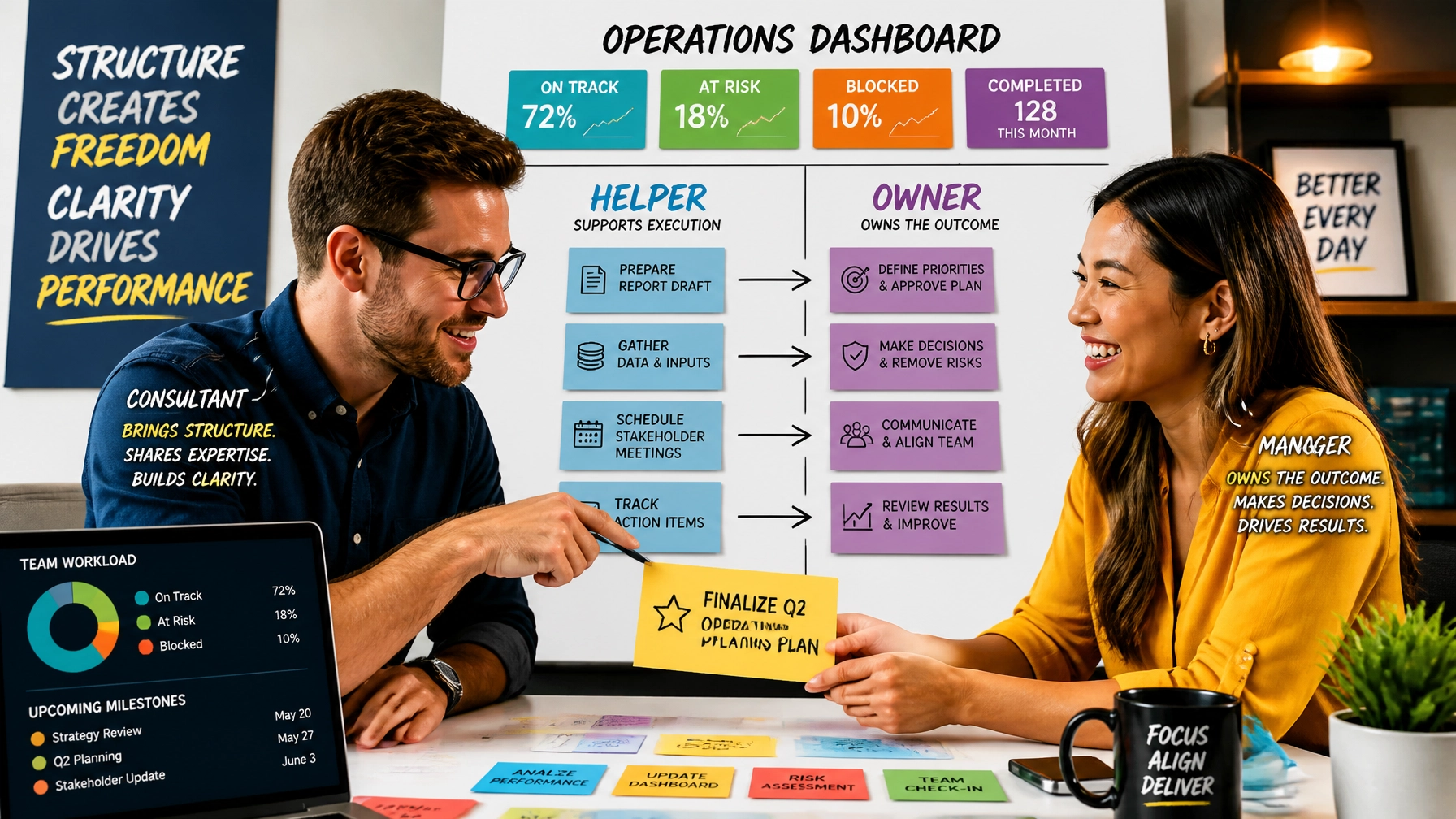
One of the most valuable distinctions we emphasize in our business coaching and franchise consulting work is the difference between helpers and owners.
- Helpers focus on tasks. They complete what is put in front of them, check boxes, and wait for the next instruction. If the list runs out, they stop.
- Owners focus on outcomes. They understand the end result they are responsible for achieving, anticipate problems, and take initiative to solve them within their defined scope of authority.
Most founders build businesses by hiring helpers and treating them like task-doers forever. Then they wonder why the business cannot scale without their constant supervision.
During my years managing multi-unit operations and supporting franchise networks, I saw firsthand that people rise to the level of clarity you provide them. If you only give people a list of tasks, you get task-doers. If you give them a defined area of responsibility, clear success metrics, and actual decision rights, you develop owners.
This transition is the cornerstone of effective leadership development. You cannot coach someone into becoming an independent operator if their boundaries change every time the wind blows.
Why Delegation Fails: It’s Not Trust, It’s Structure
Business owners often say, "I tried delegating that task, but they messed it up, so I just took it back."
That sentence reveals a fundamental misunderstanding of delegation. True delegation is not dumping a task on someone's desk and crossing your fingers. Delegation requires four structural components:
- A Defined Outcome: What does finished and correct look like?
- Decision Rights: What can this person decide on their own, and what requires escalation?
- Resources and Training: Do they have the tools, SOPs, and training to succeed?
- An Accountability Rhythm: How and when will we review progress?

When any of these four elements are missing, delegation fails. And when delegation fails repeatedly, trust erodes. The owner concludes that nobody else can do the job right.
As a business consultant, I often remind founders: If you delegate a task without defining the framework around it, you haven't delegated, you've abdicated. And abdication always leads back to chaos.
Questions to Diagnose Your Role Clarity
To find out where role ambiguity is draining energy in your organization, pause and ask yourself these core questions from our operational framework:
- Who owns specific outcomes when you are not in the room? If you stepped away for two weeks, would your team know who is definitively accountable for customer satisfaction, labor cost control, and inventory accuracy?
- Where are responsibilities shared in a way that creates confusion? If two people are technically responsible for marketing or scheduling, nobody is responsible. Shared accountability without a clear primary owner is a recipe for finger-pointing.
- Are your operational procedures documented? If your standard operating procedures (SOPs) live entirely inside your head, your team has no objective standard to measure their own performance against.
When these questions go unanswered, accountability becomes emotional. Performance reviews turn into arguments about feelings ("I thought you were going to handle that!" vs. "No, that was your job!") rather than objective discussions about systems and metrics.
Building Role Clarity That Outlasts Personality
Creating robust business systems means designing roles that can function independently of any single individual's personality or charm.
Here is how you start bringing structural clarity back to your operations:
1. Document the Core Responsibilities
For every role in your business: from front-line team member to general manager: write down the top 3 to 5 core outcomes they are responsible for delivering. Keep it concise. Focus on results, not just daily chores.
2. Explicitly Define Decision Rights
Make it crystal clear what decisions an employee can make independently. Can a shift lead comp a meal up to $15 without approval? Can a store manager adjust scheduling hours within a 5% window? When decision boundaries are transparent, speed increases and operational bottlenecks disappear.
3. Tie Roles to Measurable Standards
Connect every role to clear metrics. If customer satisfaction scores drop, the person whose role owns that outcome should be the first to notice and investigate.
4. Review and Refine Regularly
Roles evolve as businesses grow. Use regular check-ins and operational reviews to ask your team: What is currently unclear? Where are handoffs breaking down? Treat role clarity as a living system, not a dusty document in a filing cabinet.
Moving Forward With Confidence
If your business feels heavy, exhausting, or overly dependent on your personal heroics every single day, do not rush to hire more staff or buy more software. Take a step back and examine your structure.
Whether you are exploring franchise advisory services as a prospective buyer or seeking franchise expert advice to tighten your existing multi-unit operations, the guiding principle remains the same: Clarity beats complexity every time.
Take the time to define who owns what. Give your people the structure, training, and decision rights they need to succeed. You might just find that your people were never the problem: they were simply waiting for a clear map.
If your business is growing but the day-to-day operations still rely too heavily on your constant intervention, it is time to build a clearer structure. El Jefe Enterprises helps founders and operators simplify complexity, strengthen their systems, and lead with confidence. Reach out today to start the conversation.
Let’s talk about your next move
No pressure and no obligation. The goal of the first conversation is simple: clarity.
Book a callRelated reading

Is a Franchise Consultant Really Free? How It Works in Atlanta
by Johnny Tellez | Oct 26, 2026
Short answer: yes. A good franchise consultant costs you nothing. That's usually the moment people get suspicious. Fair enough. If you're thinking about buying a franchise in Atlanta, you should know exactly who's paying, why, and what that means for the advice you get…
Read more
Business Coaching in Atlanta: 7 Signs Your Small Business Is Ready for a Coach
by Johnny Tellez | Oct 26, 2026
Atlanta is one of the best places in the country to own a small business. From Buckhead to Decatur, from Marietta to the Westside, owners are opening shops, service companies and franchises every week. But building something and running it well are two different jobs. A lot of good owners hit a point where hard work alone stops…
Read more
Is Your Business Stuck? Here’s How the Five Pillars of Operational Clarity Diagnose the Real Problem
by Johnny Tellez | Oct 1, 2026
Most business owners don’t realize they are stuck until they are exhausted. You started with a vision. You had the energy. But somewhere between opening the doors and reaching your first major milestone, the "grind" became the "norm." You find yourself putting out the same fires every Tuesday, answering the same questions from your team…
Read more