The Ultimate Guide to Scaling Your QSR: Everything You Need to Succeed
by Johnny Tellez | Aug 26, 2026

Most Quick Service Restaurant (QSR) owners don’t struggle because they lack passion or a good product. They struggle because they get caught in the "founder’s trap", a state of perpetual chaos where every decision, every problem, and every shift depends entirely on them.
Scaling a business is not about doing more of what you’re currently doing; it’s about doing things differently. It is the transition from Chaos to Clarity.
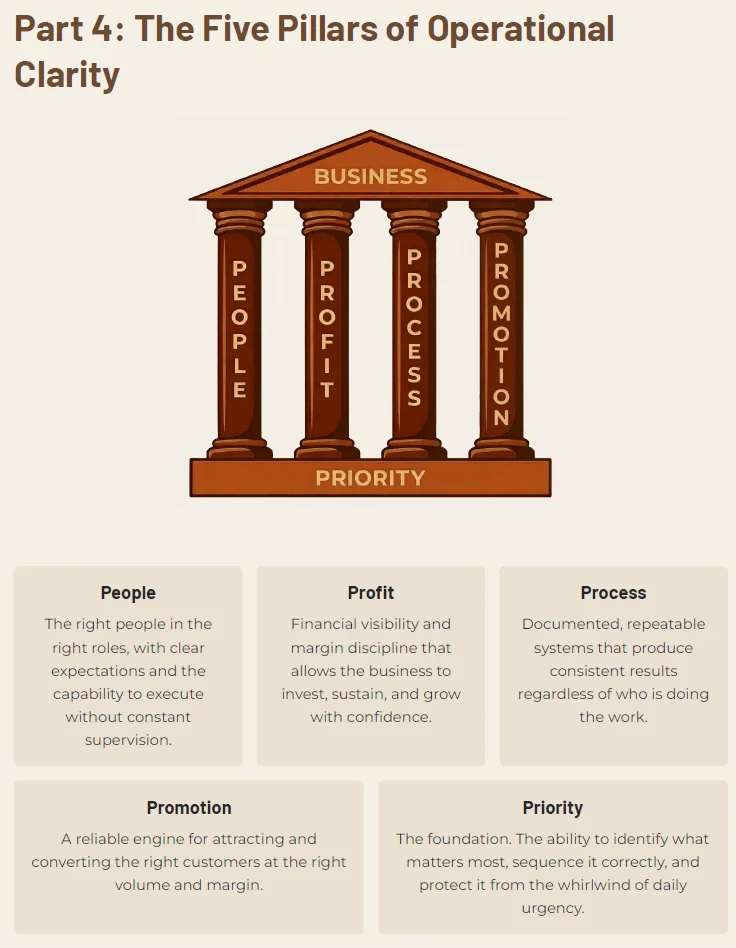
When I was leading operations and systems for brands like Focus Brands and Blaze Pizza, I saw firsthand that the difference between a single-unit success and a multi-unit empire isn't luck. It’s a framework. At El Jefe Enterprises, we break this down into five core pillars: People, Profit, Process, Promotion, and Priority.
If you want to scale your QSR without losing your mind (or your margins), you need to move these five pillars from your head onto a roadmap that your team can follow.
The Foundation: Priority
Before you hire your next manager or sign a lease on a second location, you have to establish your Priority.
Scaling requires an intentional sequence. If you try to fix your marketing (Promotion) before you fix your consistency (Process), you’re just spending money to show more people that your service is slow. Priority is about choosing the "critical few" over the "anxious many."
In the early stages of scaling, your priority shouldn't be "growth at all costs." It should be operational readiness. Are your current units stable? Is your turnover manageable? Are your financials predictable? If you can’t answer "yes" with data, your priority is to stabilize the foundation before adding more weight to the structure.
Pillar 1: People – Building a Talent Engine
You cannot scale a business if you are the only one who knows how to run it. Scaling is a human exercise. As you grow, your role shifts from "Expert Operator" to "Leader of Operators."
Define Role Scorecards
Most QSRs hire based on "vibes" and a pulse. To scale, you need Role Scorecards. A scorecard isn't a job description; it’s a list of the 5–7 measurable outcomes that define success for a role. For a General Manager, this might include labor percentage, 90-day retention, and guest satisfaction scores. When people know exactly how they are being measured, they can lead themselves.
The Training Path
Training should create confidence, not just compliance. At scale, "watching over someone's shoulder" isn't a training program. You need a documented path: Crew → Shift Lead → AGM → GM. Each step should require a certification: a literal "check-the-box" moment where they prove they can execute the standards without you in the building.
Pillar 2: Process – The Engine of Consistency
Consistency is the only way to build a brand. If a guest gets a perfect burrito on Tuesday but a cold one on Friday, you haven't built a brand; you've built a gamble.
Document the "One Best Way"
Processes are how you get the business out of your head. You need a living operations playbook that covers everything:
- Opening/Closing Checklists: These ensure the "boring" stuff gets done every single time.
- Prep Guides and Pars: Stop guessing how much chicken to cook. Use data-driven pars to reduce waste and ensure freshness.
- Station Diagrams: Every inch of your kitchen should be optimized for throughput. If a team member has to take three steps to reach the napkins, that’s a process failure.
Leverage Frictionless Technology
Technology should serve the process, not the other way around. Whether it’s a unified commerce platform for digital orders or a Kitchen Display System (KDS) that routes orders efficiently, your tech stack should reduce the cognitive load on your team. The goal is better rhythm, not more screens.

Pillar 3: Profit – Protecting the Unit Economics
Revenue is a vanity metric; profit is sanity. When scaling, you must ensure that every new location strengthens your system economics rather than diluting them.
Ruthless Prime Cost Control
In the QSR world, your "Prime Cost" (COGS + Labor) is your lifeblood. You should be aiming for a specific target: typically between 55% and 60%: depending on your concept.
- Food Cost: Regular line checks, theoretical vs. actual usage reports, and standard recipes are non-negotiable.
- Labor: Schedule to sales forecasts, not habit. If Tuesday mornings are slow, don't staff like it’s a Friday night just because "that’s how we’ve always done it."
Transparent P&Ls
Give your GMs a seat at the table. If they don't understand the P&L, they can’t help you improve it. Create a simple "Weekly Mini-P&L" that tracks sales, labor, and food cost. When managers see the direct impact of a wasted case of lettuce or an extra hour of overtime, they start acting like owners.
Pillar 4: Promotion – Driving Sustainable Demand
Promotion is the fuel that keeps the engine running, but it has to be profitable. Many owners make the mistake of discounting their way to a "busy" restaurant while losing money on every transaction.
Local Store Marketing (LSM)
While digital ads have their place, the "four walls" of your community are where the real growth happens. Give your GMs an LSM playbook:
- Partnerships with local schools or offices.
- Fundraising nights for community groups.
- Sampling at nearby high-traffic events.
The Digital Guest Engine
In today's market, you need to own your data. Third-party delivery apps are a great tool for reach, but the margins are thin. Your goal should be to migrate those guests into your own loyalty program or app. Once you have their data, you can drive frequency through targeted "win-back" offers or rewards, rather than blanket discounts.
Moving from Chaos to Clarity
Scaling a QSR is a journey of letting go. You have to let go of the "heroics" and start trusting the systems.
If your business currently feels like a series of fires you have to put out every day, take a step back. Look at these five pillars. Where is the gap? Usually, it’s not a lack of effort; it’s a lack of structure.
At El Jefe Enterprises, we help owners simplify this complexity. Whether you are looking to buy your first franchise or you’re a founder looking to scale your current brand, we provide the real-world operational insight to help you move forward with clear, confident decisions.
Don't just work for the crust. Build a system that lets you own the pie.
If you’re ready to stop being the bottleneck in your own business, let's look at the process behind the problem. Learn more about our approach to operational clarity here.
Let’s talk about your next move
No pressure and no obligation. The goal of the first conversation is simple: clarity.
Book a callRelated reading
Is a Franchise Consultant Really Free? How It Works in Atlanta
by Johnny Tellez | Oct 26, 2026
Short answer: yes. A good franchise consultant costs you nothing. That's usually the moment people get suspicious. Fair enough. If you're thinking about buying a franchise in Atlanta, you should know exactly who's paying, why, and what that means for the advice you get…
Read more
Business Coaching in Atlanta: 7 Signs Your Small Business Is Ready for a Coach
by Johnny Tellez | Oct 26, 2026
Atlanta is one of the best places in the country to own a small business. From Buckhead to Decatur, from Marietta to the Westside, owners are opening shops, service companies and franchises every week. But building something and running it well are two different jobs. A lot of good owners hit a point where hard work alone stops…
Read more
Is Your Business Stuck? Here’s How the Five Pillars of Operational Clarity Diagnose the Real Problem
by Johnny Tellez | Oct 1, 2026
Most business owners don’t realize they are stuck until they are exhausted. You started with a vision. You had the energy. But somewhere between opening the doors and reaching your first major milestone, the "grind" became the "norm." You find yourself putting out the same fires every Tuesday, answering the same questions from your team…
Read more